
No Weld. No Compromise.
Built Different.
Built Better.
No Welding Required.
For over 70 years, A&J Manufacturing has pioneered a proprietary bolted aluminum construction method that outperforms welded enclosures in modularity, field serviceability, and long-term reliability.

Why Welding Falls Short in Defense Applications
Welded enclosures have been the industry default for decades — and for low-stakes commercial applications, they get the job done. But defense programs aren't low-stakes. They run for years, payloads evolve, requirements change, and equipment has to survive in some of the harshest environments on earth. In that context, the tradeoffs of welded construction stop being acceptable and start being liabilities.
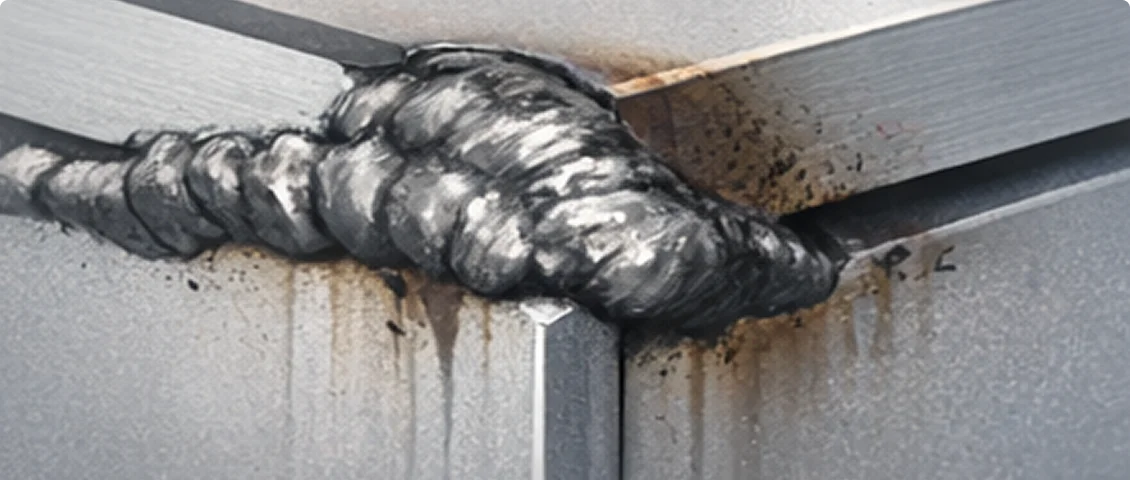
Heat Distortion
Welding generates intense, localized heat that aluminum absorbs unevenly. The result is thermal stress — and thermal stress means warping. Even minor distortion can affect panel fit, mounting tolerances, and EMI gasket interfaces, creating downstream integration headaches that are expensive to diagnose and even more expensive to fix. On a program where dimensional precision matters, this is a risk that simply doesn't exist with bolted construction.
Permanent Construction
A welded enclosure is essentially a one-time decision. Once the joints are fused, any modification — adding a shelf, relocating a mounting point, accommodating a new payload — means grinding down the weld, re-welding, and re-finishing the affected surfaces. On a long-lifecycle naval program where requirements routinely evolve post-CDR, that rigidity translates directly into schedule delays and unplanned NRE costs. Field modifications are often impractical entirely, requiring the unit to be pulled from service and returned to a facility.
Weight Penalty
Weld joints are inherently less efficient than mechanically fastened ones. To achieve comparable structural integrity, welded designs require additional material around the joint — thicker walls, reinforcement gussets, or supplemental brackets. On a shipboard rack where every pound contributes to the payload budget and affects isolation system sizing, that added weight has a real downstream cost. A&J's bolted extrusion system is engineered to carry the load without the extra material — keeping the structure light, strong, and optimized from the first design iteration.
Our Proprietary Extrusion System
-Engineered from the Ground Up
A&J's aluminum extrusion system didn't come from a catalog. It was developed entirely with private funds — a proprietary trade secret conceived in-house, refined across 1,000+ programs, and protected for over 70 years. No other manufacturer uses it. No off-the-shelf system comes close to replicating it. From the geometry of the extrusion profiles to the hardware specifications that hold them together, every element was designed from the ground up with one goal in mind: to deliver the modularity, weight efficiency, and environmental durability that defense electronics enclosures demand — and to keep delivering it program after program, decade after decade.
All-Bolted Assembly
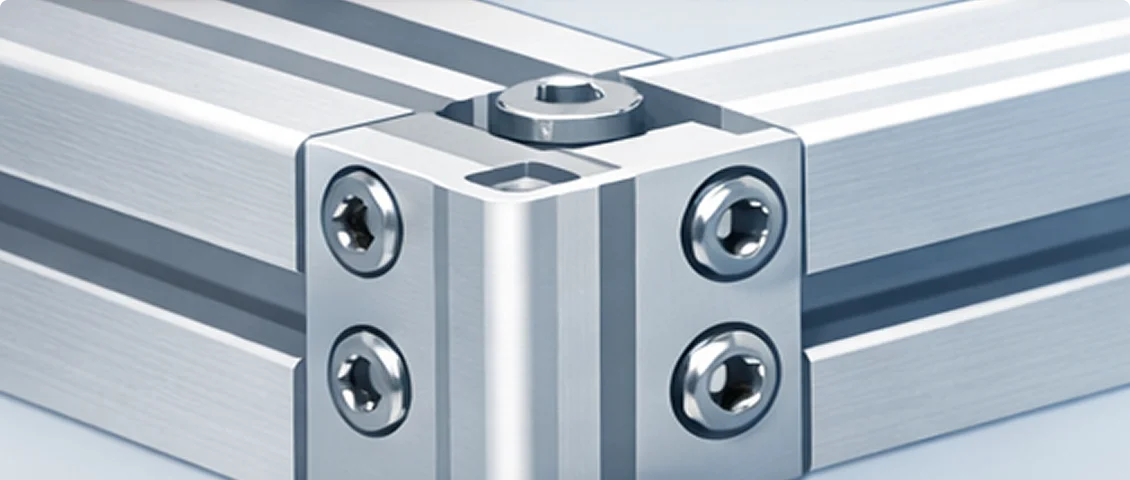
Every joint is mechanically fastened using non-magnetic stainless steel hardware. No heat, no distortion, no permanent bonds.
Proprietary Aluminum Extrusions
Custom-designed extrusion profiles developed exclusively by A&J accommodate a wide range of payload requirements from light to heavy duty.
Modular by Design
The t-slot frame system allows nearly infinite vertical equipment positioning, enabling fast reconfiguration without any structural modification.
Field Serviceable
Any panel, shelf, or component can be removed and replaced in the field without special tooling or facility support — critical for long-lifecycle naval programs.

Bolted vs. Welded -- See the Difference
| Features | A&J Bolted Construction Advanced Modular Design | Traditional Welded Conventional Method |
|---|---|---|
| Heat Distortion | None | Common - localized heat warps aluminum and affects tolerances |
| Field Reconfiguration | Fast - no tools required | Requires grinding, re-welding, and re-finishing at a facility |
| Panel Removal | Fully removable - any panel can be taken off without structural impact | Often fixed or permanently bonded to the frame |
| Weight | Optimized | Heavier reinforcement required |
| Modification Cost | Low - design changes accommodated without structural rework | High - any modification triggers NRE |
| Lifecycle Serviceability | Excellent - fully disassemblable and reconfigurable in the field | Limited - field modifications often impractical without facility support |
| Hardware | Non-magnetic stainless steel throughout | Varies |
| MIL-STD Compliance | MIL-STD-901E, MIL-STD-167-1A | Varies |
| Environmental Finish | MIL-DTL-5541 chemical film + MIL-STD-1303 primer and topcoat | Varies - weld seams can compromise finish adhesion and corrosion resistance |
| Production Lead Time | Streamlined - modular assembly from proven standard platform | Longer - welding, cooling, inspection, and rework add time |
Welded construction trades long-term flexibility for short-term familiarity. A&J’s bolted system was purpose-built to eliminate that tradeoff — giving program managers a rack that’s easier to qualify,
easier to modify, and easier to support for the full life of the program.
Battle-Tested Across 1,000+ Defense Programs
A&J's bolted construction isn't theoretical. It has been qualified and fielded across some of the most demanding shipboard and defense programs in the U.S. military — programs where failure is not an option.
Ground


Shipboard


Airborne


Built to Survive Whatever the Mission Demands
A&J Manufacturing has maintained compliance with these standards across 1,000+ programs and seven decades of defense production. When you specify an A&J enclosure, you're not betting on a supplier who is new to the requirements — you're partnering with one who helped define what meeting them looks like.

MIL-DTL-901E
High-impact shipboard shock
(Grade A, Class II, Type A — DSSM)

MIL-STD-167-1A
Shipboard vibration
(Type 1, deck-mounted)

MIL-STD-810H
Environmental conditions including temperature, humidity, and salt fog

MIL-DTL-5541 / MIL-STD-1303
Chemical film treatment and paint finishing standards
From Extrusion to Delivery:
All Under One Roof

From Extrusion to Delivery:
All Under One Roof

01 .Design
A&J engineers develop the configuration using our proprietary extrusion platform and customer-provided requirements. STP models and drawing packages provided at each design review.

02. Fabricate & Assemble
All fabrication, assembly, finishing, and quality inspection is performed at our 45,190 sq. ft. facility in Foothill Ranch, CA — zero outsourcing, total process control.

03. Deliver & Support
Units are delivered qualification-ready with full documentation — FAI report, BOM, drawing package — and backed by A&J's one-year limited warranty.
Qualified. Certified. Ready to Work
Certifications in the defense supply chain aren't formalities — they're how program managers and prime contractor procurement teams vet suppliers before a program ever gets started. They represent a commitment to process discipline, quality traceability, and regulatory compliance that customers shouldn't have to take on faith. A&J maintains the full set of certifications that defense programs require, audited and current.

AS9100D

ISO 9001:2015

WOSB

CAGE: 08060

ITAR Registered
All design, fabrication, assembly, inspection, and shipping is performed at our secure facility in Foothill Ranch, CA.
Ready to Build Something that Lasts?
Whether you’re in the early stages of a new program or ready to move straight to quoting, A&J is ready to help. Share your requirements and we’ll get back to you quickly — no bureaucracy, just engineers who know what they’re doing.